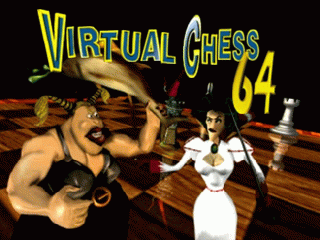
Virtual Chess 64 is a chess simulation game for the Nintendo 64. It was first released in 1998. It was also considered to be very difficult. The game featured no true 'completion' in the form of a goal or a score, so one could theoretically play an endless number of matches. One feature that made the game interesting is that when a piece was captured, a short animated cutscene would play back depicting the battle, as in 1988's Battle Chess.
Virtual Chess 64 came with a basic text and visual tutorial written for beginners and novices about how to play chess. In the third section the tutorial continues explaining how to play using simple chess positions in which you learn from by finding the best move each time. The short fourth section is analysis of two badly played well-known games titled 'Fool's Mate' and 'Scholar's Checkmate'. In the fifth and sixth sections these chess problems become increasingly complicated, and the player is expected to, by some means, find the solution and understand it. The seventh section is about basic endgame checkmating approaches and patterns, and just one basic endgame concept for beginners: the square of the promoting pawn. The last three sections focus on improving opening, middlegame, and endgame chess play by using example games for analysis.
The tutorial does not extend enough to teach how to win a game against the chess engine featured in this game, but it is enough to inspire some to learn more through other sources. The only spoken part of the tutorial are the comments on the chosen correct moves listed (below) in order of first-to-last spoken as you answer tutorial challenges. (In a few cases the comment is randomly chosen, so the order is approximate.)