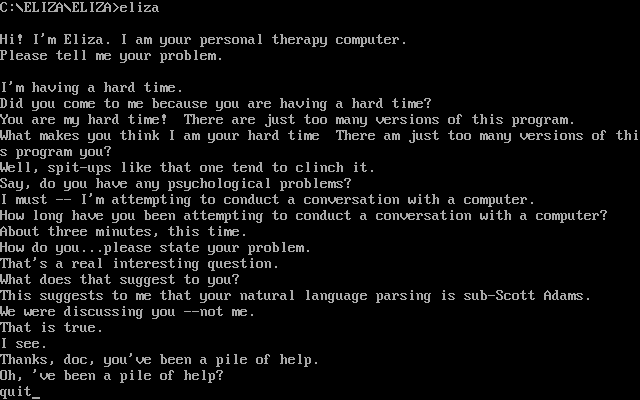
Eliza was the first chatterbot to make a splash in popular culture, originally written and conceived by Dr. Joseph Weizenbaum of MIT in 1966 to mockingly ape the style of a person-centered (Rogerian) psychotherapist or counselor, largely by prompting the user to elaborate on topics sampled from previous user input. A typical session would take the form of a typed dialogue (sometimes with simulated typing errors to further the suspension of disbelief), with the computer asking the user a series of questions and being fed responses from which to generate further questions.
The game stimulated early consideration of computer artificial intelligence (or the appearance thereof), not infrequently passing the Turing test and fooling users into believing (for a little while, at least) that they were interacting with a real human being on the other end... blazing a trail subsequently followed down by Perry the Paranoid and Racter. Additionally, the nods its conversational interface made toward natural language processing (or, again, the appearance thereof) are considered to have been influential on the early mainframe development of the interface for text adventure games such as Adventure and Zork.
Considered as a game, it is nearly the polar opposite to Emily Short's Galatea -- instead of the player probing the computer with questions, the computer probes the player with them. Many different stories will still be revealed, but in this case, that's because it'll be people tricked by the program into telling them.