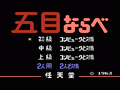
Gomoku Narabe Renju is a Japan-exclusive video game for the Family Computer (in addition to the Virtual Console) which is based on the board game Connect Five.
This game can be found in pirated multicarts under a numerous amount of alternative titles like Chinese Chess and Five Chess. Notable examples are Power Player Super Joy III and with similar Nintendo Entertainment System hardware clones; all of which are unauthorized bootleg devices that are meant to be hooked up to the player's television in some manner.
There are three difficulty levels in addition to a two-player mode - beginner (初級), intermediate (中級), and advanced (上級). Unlike tic-tac-toe where there is usually a draw if both players pay attention, there is always a possibility to win in Gomoku Narabe. Since 1936, studies have proven that players controlling the 'black' tiles can win by playing a completely perfect game. Some rules were introduced to keep the game fair and to reduce black's advantage on the board. The game follows the Renju rules. For example, the player controlling the black tiles only wins with five pieces in a row. Rows of six or more are called overlines and will result in a loss instead. White tile-controlling players, on the other hand, has no such restrictions and can win by collecting a row of five or more tiles.