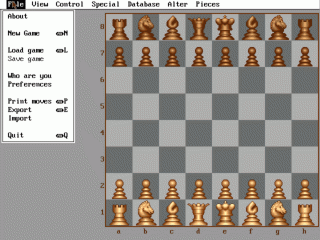
The Complete Chess System (CCS) was a commercial computer-chess program developed by Chris Whittington and published by Oxford Softworks. It first appeared for DOS in 1993, followed by an Amiga version in 1994, and it belonged to the same Oxford Softworks line that later continued with The Complete Chess System II and Chess System Tal. It combined a dedicated chess engine with its own graphical interface and was presented as a serious product for committed chess players rather than a casual board-game conversion.
The game allowed the player to face the computer in either a 2D top-down view or a 3D board perspective, and it also included a selection of historical master games. CCS offered a notably full-featured package for its time, combining the main playing engine with a game database of around 15,000 games, support for storing one’s own annotated games and variations, and the ability to work with opening books and ASCII-exported material from other chess software. It also included a built-in test designed to estimate the user’s playing strength after solving a set of positions.
What distinguished CCS most strongly was its playing style. The program relied on selective search rather than sheer brute-force calculation, making it in some ways the opposite of programs such as Sargon 5. That selectivity sometimes led to occasional oversights, but it also gave the engine a more human character, with flashes of original ideas rather than purely mechanical play. CCS could also be especially weak in blitz chess, where highly selective engines often suffer because they need more thinking time.
In practical terms, CCS aimed at the stronger end of the market. Its hardware requirements were relatively demanding for the period, and its maximum playing strength was estimated at about 2050 Elo on a 486/50 with 16 MB RAM. At the same time, the interface was generally regarded as attractive and usable, even if some actions—such as setting up positions—were handled less elegantly than in competing products. The manual was available only in English, which may have limited accessibility for some players outside the English-speaking market.
As a contemporary chess program, The Complete Chess System occupied an interesting middle ground between consumer-friendly GUI chess software and stronger specialist engines. It was remembered as a technically ambitious and commercially significant title, with a solid reputation that later successors built upon. Even if it was not flawless, CCS stood out as a thoughtful and serious chess package whose strengths lay in its selective engine, broad feature set, and clear ambition to appeal to players who wanted more than a simple electronic opponent.