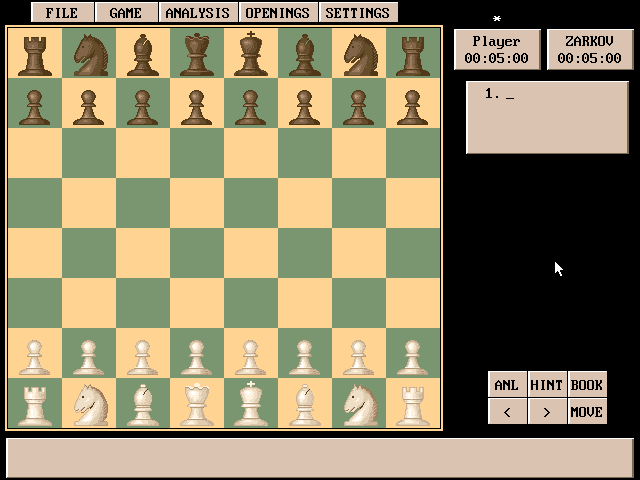
Zarkov is a commercial chess program by John Stanback written in C. He began writing Zarkov in 1988 after finishing version 2.0 of Gnu Chess. The first version was similar to Gnu Chess in search and evaluation, but he changed the data structures to make move generation and attack table generation more efficient. He also spent a lot of time playing it against his Fidelity Excellence and trying to fix the search or evaluation function when he encountered strange behavior or got into tactical trouble. He said: 'Playing lots of games by hand is a really valuable method for finding and fixing problems. I don't do much of that anymore, but I should. I considered the hardware I was using at the time to be pretty state-of-the-art: an 8 Mhz 286 PC with two 1.2M floppies and no hard drive. The A drive contained the most useful MSDOS commands, a simple editor that I wrote, and the Borland C compiler. The B drive contained the source and executables for Zarkov. I don't think compiles took any longer than they do now on a computer that's about 200 times faster! In between making changes to the chess engine I created a graphical interface for Zarkov. I had to learn sort of esoteric stuff like using mouse interrupts and writing to DOS video memory.'
In 1991, version 2.5 was released. John Stanback discovered how to prune the tree with a reasonably effective selective search technique which relied on a combination of evaluation function heuristics and reduced depth search. This change alone improved the engine by about 100 rating points. He also added more evaluation function heuristics, improved the search extensions, and improved transposition table operation. He tuned the evaluation function by running hundreds of self-play blitz games where the weights for each heuristic were randomly assigned one of two weights (slightly lower or higher than 'normal' value for that heuristic). Based on the results, the 'normal' values of the weights were modified and the process repeated. The net result was a big improvement in playing strength.
This version of Zarkov is 3.0. It was released in December 1993. For this version, John Stanback completely rewrote the interface, using some of the code he developed for Grandmaster Chess. He also went back to the selective search technique that he used for version 2.5, but with some improvements. He did a lot of work on search extensions, but it's not clear how much this improved the program. He set up the capability to play automatically at night against the Saitek Leonardo modules and against the Novag Forte C. Matches against these programs indicated a significant increase in program strength.