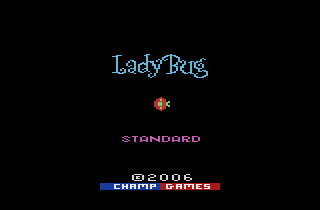
Lady Bug is a maze-chase video game originally released in arcades by Universal in 1981. Its basic concept resembles Pac-Man, but movable gates let the player change routes through the maze. The Atari 2600 version is a later homebrew adaptation programmed by John W. Champeau of Champ Games and released in 2006. It brings the original combination of collecting food, avoiding insects and manipulating passages to hardware that did not receive a published version during the game’s original commercial period.
The player guides a ladybug through a garden, collecting flowers, hearts and letters while avoiding predatory insects. Clearing the required objects leads to the next maze. Enemies emerge from the central enclosure at intervals, so the pressure builds as more pursuers enter the playfield. A timer running around the border signals their release, making the edge of the screen useful information as well as a boundary.
The rotating gates are the main distinction from an ordinary chase maze. Pushing through one changes its orientation and redirects movement along neighboring corridors. The player can therefore interrupt a pursuit or open a more convenient route to remaining food. This emphasis on changing passages also invites comparison with Mouse Trap, although Lady Bug uses individual rotating gates. Escaping depends on reading the maze and preparing routes rather than simply running faster than the insects.
Poison symbols add a stationary danger: contact is fatal to the ladybug, but can also eliminate a pursuing insect. A vegetable appears in the central enclosure after the enemy insects have entered the maze. Collecting it awards bonus points and temporarily stops the pursuers, creating an opportunity to gather food or reposition. The pause does not turn the enemies into edible targets, so approaching them still requires caution.
Hearts and letters cycle through different colors, and the moment of collection affects their value and purpose. Blue hearts increase the score multiplier, progressing through double, triple and fivefold scoring for the current maze. Collecting a heart in another color provides points without that improvement. This adds a scoring decision to the chase: an immediately accessible object may be more useful if collected later, but waiting also gives the insects time to approach.
The letters provide two longer-term objectives. Yellow letters build the word EXTRA, earning another ladybug, while red letters build SPECIAL. In this Atari 2600 version, completing SPECIAL opens the Veggie Bounty Harvest bonus maze, where vegetables provide further scoring opportunities. This differs from the original arcade reward of a free game. A letter collected in an unsuitable color contributes points but does not advance the corresponding word, so successful collecting combines navigation with timing.
The adaptation preserves the interplay between maze control and bonus collecting while giving the Atari 2600 its own version of the game decades after the arcade release. Its central challenge remains managing several aims at once: clearing food, keeping an escape route available and collecting the right colors for multipliers and letter bonuses. The 2006 release is also an example of later homebrew development extending the console’s library with an adaptation missing from its original era.